
GenAI is very noisy: an endless sequence of rumorous waves of innovation, where the only constant is the next one. This thing is changing so fast that one may even be tempted to simply give up trying to keep up and start to feel annoyed by it.
The conversations we keep having with clients mirror this noisy landscape. It’s fast, it’s incredible, it’s immature, it’s disruptive, it’s a bubble, we’re behind, we’re ahead, we have a partnership with this and that…
The business world looks like a crowded chatting beach where some had to jump in the GenAI waves and surf, because their business saw a dramatic disruption, and some are watching the waves - talking about surfing.
There’s an ocean of talkers and a handful of surfers.
(attributed to multiple riders)
Moving from the beach to the boardroom, are the ones not surfing just not seeing the value or not brave enough? Trying their shoes - i.e. the shoes of someone whose decisions influence thousands (and at the same time would not like to be fired) - here how GenAI may feel:
Unknown. I don’t fully understand it (and I don't dare to say so in public).
Confusing. Too many potential applications, impossible to prioritise.
Risky. Compliance, operational, security, and reputational hazards everywhere.
Cost question mark. Consumers may think it's for free, but GenAI based enterprise solutions are not. No history to back up estimates of run / monitor / upgrade costs.
Slippery ROI. It evolves too fast - I’m here about to capitalise on an investment, and again a new thing makes my efforts dated. I don’t know what wave I should jump on.
Hard work. Value capturing means transformation, restructuring (= firing many or at least stop hiring now), reshaping people and processes, change management.
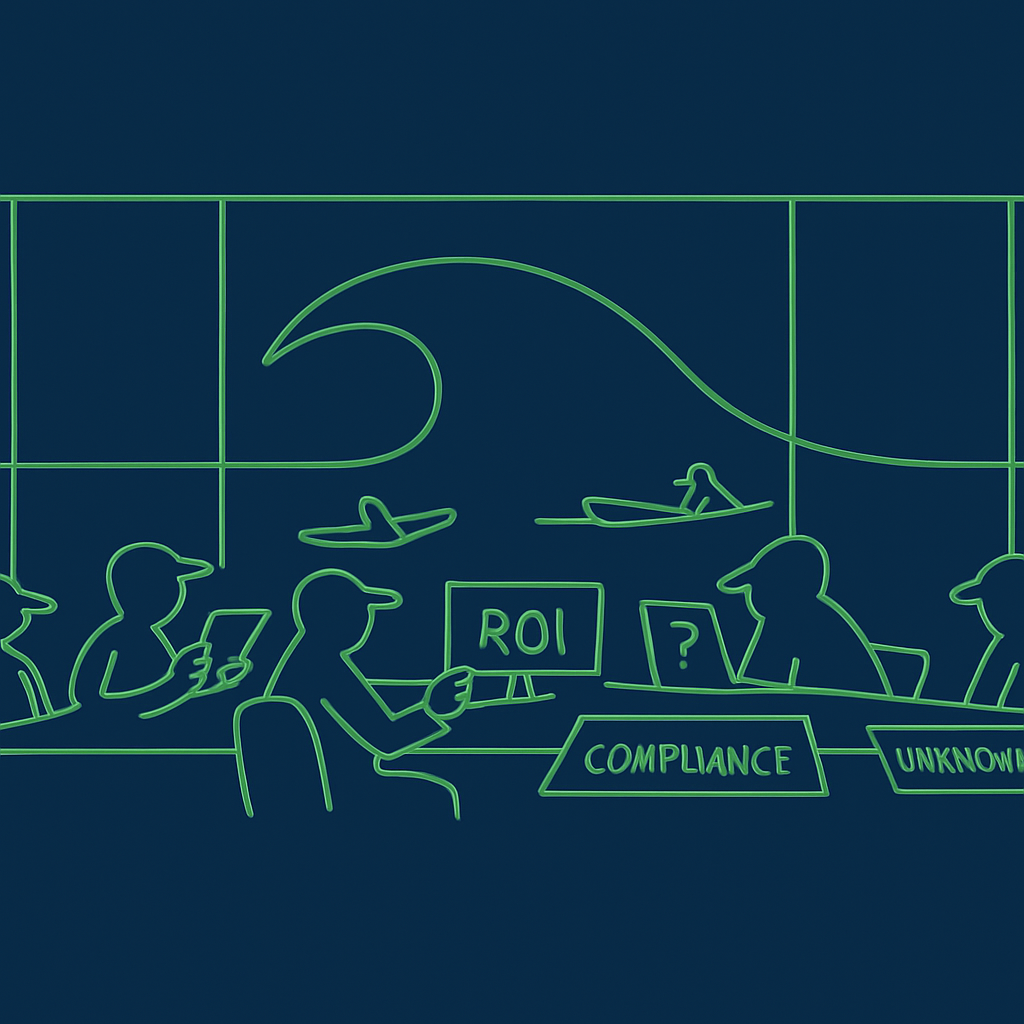
Why on Earth should I, as a responsible Manager, hurry in that water? I’ll keep watching from the beach rather than paddling out. Resist the FOMO. Wait for the bubble to burst.
But there is another recurring feeling to add to the list: GenAI is bothersome - I can't really ignore it. Someone, a CEO or the Shareholders or the Market/Clients, is pushing me to spend time looking into it—i.e., to at least splash myself a bit into the waves.
You can’t stop the waves, but you can learn to surf.
Jon Kabat-Zinn
Over the past years we understood that to fully grasp what it is, where it can be used, how it should be implemented, how much it costs, and to stay updated, it is a full-time job.
Expertise is emerging from using GenAI and implementing it into processes and systems, jumping from one wave of new tools to the next one. There’s a lot to study and to analyse, yes, but practice matters most, at least at this stage of maturity of GenAI.
In what sequence should an organisation practice, i.e. what could be a path for adoption? Let’s try to find a path by unpacking this simplified definition of what GenAI is:
A new tech toy, non-deterministic and generative, that can automate tasks & augment humans, and that introduces a new type of human-to-machine interface.
GenAI is a “tech toy”. Naturally, the first adopters should be the tech crowd, the internal Digital/IT teams, applying it in their own processes and delivery. And by doing so, accumulate experience on technology, e2e processes redesign and change management challenges. Many learnings, if not all of them, can be reused elsewhere in the organization.
GenAI is “generative”. Marketing is another candidate for early adoption, for sure right away for content creation. And then for insights capturing: the search engines were simply listing you, while ChatGPT, Perplexity & friends are practically giving their opinion on you, your brand, your products. Better to be aware of what LLMs are telling to your customers.
GenAI is “automation & augmentation”. Next move, have a look at “backoffices”. Target personal productivity first, then GenAI-automate a step or two in a process - without changing the process itself - then full e2e redesign of processes leveraging the right mix of GenAI capabilities and human controls.
GenAI is a "new type of human-to-machine interface". Enter finally into high-value/ high-complexity/ high-risk domains, blending GenAI capabilities into the Channels and Sales & Client Services processes. The potential is huge - as well as the complexity - in the design and implementation of the next generation of GenAI-rich Front Ends (including voice!). Within this domain, it may be wise to start looking into the tools supporting Human-to-Human sales and services interaction before leaving GenAI talking alone with your customers.
GenAI, combining all above, could be a “game changer”, up to challenging the existing value chains in an industry. It opens new options to enrich the existing value propositions and to launch new ones not accessible / not profitable / not strategic before. Once the internal understanding of how to use GenAI is solid and backed by real experience - then it comes time to understand what to change on the Business Strategy as whole.
It may be a surprise to see the Chatbots for Client and the Business/AI Strategy at the end instead of the beginning of the sequence - our perspective is that certain topics are better solved when the organisation's understanding of GenAI is (a) shared and (b) mature enough.
That path, or any other possible variation, may be just the beginning, or even a false start, yet it will build the muscles to learn surfing, including mastering the falls from the board.
If in doubt, paddle out.
Nat Young
At Enrian, we don't remember anything of such speed and with such impact on knowledge work, not just on manual tasks automation. Many fear it will destroy more jobs than it creates and that very hard work is needed for a responsible, ethical and meaningful adoption.
Not to mention the financial implications. For the foreseeable future, the GenAI challenges of unclear operating costs and slippery ROI may remain a fact that can’t be denied nor changed.
If this is true, what about embracing it and taking the full risk? Or - if too much - sandbox it in a confined perimeter? Not “another” POC, but a real specific business perimeter that can be scaled later - eventually - yet small enough to be disposable.
One team, one process, or one project.
Our choice is to experiment with something different every time we start a new project, and then compare and share learnings, ensuring we never put all our eggs in one basket.
Within that perimeter, one should do whatever possible to go very deep and release constraints to boost experimentation and fast adoption. And assume that the journey matters more than the outcome, and the only guaranteed Return On Investment is learnings, culture and some practical insights for broader governance.
If that is not acceptable to be done internally in your organisation, if sand-boxing internally the innovation is not feasible, a safer option could be to spin it off externally and give it a bit of financing - talents love spinoffs & startups anyhow, and GenAI needs talents to take off.
The best surfer out there is the one having the most fun.
Phil Edwards

Of course, there’s always the option to stay a bit longer on the sand, read a bit more about GenAI, and have yet another talk about it. The waves won’t stop coming. We’re happy either to talk — or to jump on the board together.
_______________
A special thanks to Tony for the surfing metaphor, Elio for listening and challenging my thoughts, and to ChatGPT for helping with quotes (given my total absence of expertise in real surfing, I didn’t check whether they are all entirely legit, but I would have lost a lot of time without the help)


